Innovative Construction Techniques for Long-Span Bridges
Long-span bridges present unique engineering challenges, particularly in the methods used to construct them. Traditional approaches often become impractical or uneconomical when dealing with large structures over deep water, wide valleys, or congested urban areas. As a result, engineers have developed advanced construction techniques that enable the safe and efficient assembly of these massive structures. This article examines two prominent methods—incremental launching and segmental construction—detailing their processes, benefits, and limitations. By understanding these approaches, stakeholders can make informed decisions about the most suitable construction strategy for their specific project context.
The choice of construction method significantly influences not only the structural design but also the overall project timeline, cost, and safety. Each technique offers distinct advantages and poses specific constraints, making the selection process a critical step in bridge engineering. This discussion aims to provide a comprehensive overview of these innovative methods, highlighting their applicability in various scenarios. The focus is on the methodology and technical considerations rather than promoting any particular approach, ensuring a balanced and informative perspective.
Incremental Launching
Incremental launching is a construction technique where the bridge superstructure is assembled on one side of the span and then progressively pushed or pulled across the piers. The process typically begins with the construction of a launching girder or a temporary nose, which guides the structure as it moves forward. Segments of the deck are cast or fabricated on a stationary platform, then attached to the rear of the already launched portion, and the entire assembly is advanced using hydraulic jacks. This cyclic process continues until the entire bridge deck reaches its final position.
The primary benefit of incremental launching is the minimization of work at height or over obstacles. Since most of the construction occurs at ground or deck level, the method reduces the need for extensive falsework or scaffolding, which can be costly and hazardous in deep valleys or over water. Additionally, the repetitive nature of segment production allows for efficient use of formwork and labor, potentially leading to cost savings. Incremental launching is particularly well-suited for bridges with constant cross-sections and moderate curvatures, as the alignment must be consistent throughout the launch.
However, the technique has limitations. The structural design must accommodate the forces experienced during launching, such as alternating hogging and sagging moments, which may require additional temporary prestressing or strengthening. Furthermore, the launching process requires a continuous and unobstructed path from the casting yard to the final position, which may be challenging in constrained sites. The method also demands precise control and monitoring to ensure alignment and stability, adding to the complexity of the operation. Consequently, incremental launching is most advantageous for long viaducts with straight or gently curved alignments, where its efficiencies can be fully realized.
Segmental Construction
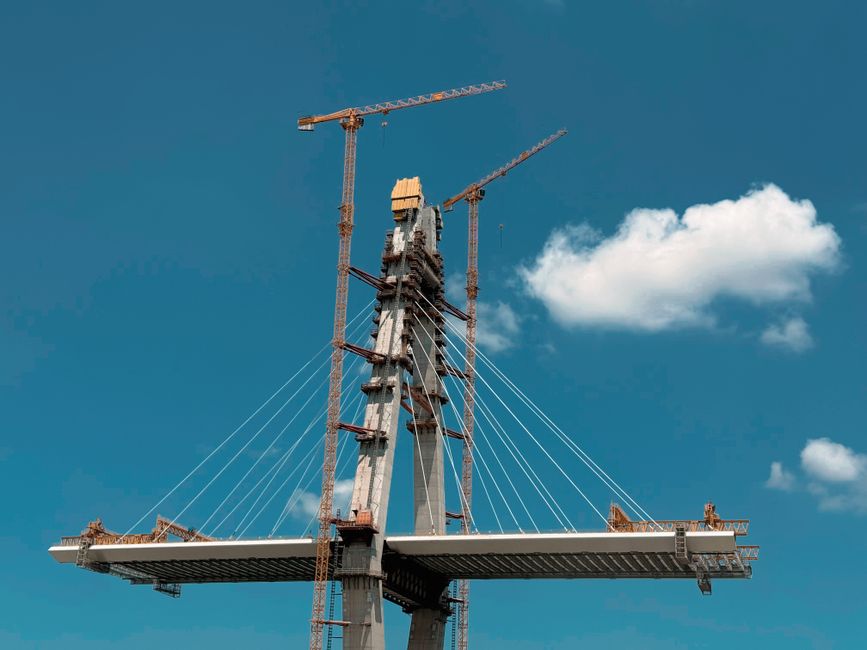
Segmental construction involves building the bridge superstructure from precast or cast-in-place segments that are assembled using either the balanced cantilever or span-by-span method. In balanced cantilever construction, segments are erected progressively from each pier outward, creating symmetrical cantilevers that are eventually joined at mid-span. This method is particularly effective for long-span bridges, as it avoids the need for temporary supports. In the span-by-span approach, segments are assembled on temporary supports and then post-tensioned together to form a complete span, which is subsequently launched or lifted into place.
One of the primary benefits of segmental construction is its adaptability to various bridge geometries, including curved and variable-depth decks. The use of precast segments allows for high-quality fabrication in a controlled environment, improving durability and reducing on-site construction time. Additionally, the balanced cantilever technique minimizes disruption to the environment below, making it suitable for crossings over ecologically sensitive areas or congested infrastructure. The method also enables parallel workstreams, with multiple piers being constructed simultaneously, potentially accelerating the overall schedule.
Despite its advantages, segmental construction presents certain limitations. The need for specialized equipment, such as launching girders or cranes with high lifting capacities, can increase capital costs. The erection process requires meticulous planning and coordination, especially for balanced cantilever construction, where the structure is highly unstable until the spans are closed. Furthermore, the numerous joints between segments can be a source of maintenance concerns, necessitating careful detailing and waterproofing. Nevertheless, when properly executed, segmental construction offers a robust and versatile solution for many long-span bridge projects.
Comparative Considerations
Choosing between incremental launching and segmental construction depends on various site-specific factors, including span lengths, foundation conditions, environmental constraints, and available resources. For structures with short to medium spans and constant geometry, incremental launching often proves more economical due to its repetitive casting process and reduced falsework. Conversely, segmental construction, particularly the balanced cantilever method, excels in situations where long spans and limited ground access are prevalent. The selection process should consider not only the initial construction costs but also the long-term maintenance implications and the contractor’s familiarity with each method.
Another critical aspect is the potential impact on the surrounding community and environment. Incremental launching, with its casting yard and launching operations, may require substantial temporary space at one end of the bridge. In urban areas, this could be a limiting factor. Segmental construction, on the other hand, may impose restrictions on the foundations and require heavy lifting equipment that could disrupt traffic or marine activities. Each method presents unique logistical challenges that must be evaluated during the planning phase. Ultimately, the decision should be based on a comprehensive analysis of the project’s specific requirements and constraints.
In the realm of long-span bridge construction, there is no universal solution; the optimal method is determined by a intricate interplay of engineering, logistical, and economic factors. Therefore, a detailed comparative assessment is essential to identify the approach that aligns best with the project’s objectives.
Innovations and Future Trends
Advancements in materials and technology are continually refining these construction techniques. For instance, the use of high-performance concrete and advanced composite materials can enhance the strength and durability of segments, allowing for longer spans and reduced self-weight. Automation and digital monitoring systems are improving the precision of launching and erection operations, minimizing human error and enhancing safety. Building Information Modeling (BIM) enables better coordination and visualization of the construction sequence, reducing conflicts and delays. Additionally, techniques such as accelerated bridge construction are gaining traction, emphasizing off-site fabrication and rapid on-site assembly to minimize traffic disruption.
While these innovations promise to expand the applicability of incremental launching and segmental construction, they also require investment in new equipment and training. Companies like BridgeWorks Engineering are at the forefront of adopting such technologies, but the industry as a whole is gradually evolving. The integration of drones for site inspection and robotic systems for automated rebar placement are examples of cutting-edge developments that could further streamline processes. As these technologies mature, they may overcome some current limitations, such as the need for substantial on-site labor and the sensitivity to weather conditions.
Nevertheless, the fundamental principles of structural engineering remain paramount. Any new method must ensure the integrity and longevity of the bridge, and compliance with relevant design codes and standards is non-negotiable. The future of long-span bridge construction lies in a balanced approach that leverages innovation while maintaining a focus on safety, reliability, and sustainability. By embracing these advancements, the industry can continue to deliver impressive structures that meet the evolving needs of society.